Use AI Against Itself
A data center is bringing AI to your town. Here’s how to make it explain itself.
At an AI and public-good conference in Pittsburgh, the moderator asked an LLM engineer who specialized in AI safety testing about data centers. He started by admitting he wasn’t an expert. He writes code, not chips. Then he said communities needed to dig into the actual data on the project proposed for their town, instead of just saying “but the water!”
A man a few rows back from me had clearly heard this before. Who, he asked, has time for that? Organizers aren’t analysts. They’re people with jobs. And they’re fighting against big money. It got heated enough that the whole room had to stop and do a box breath.
Then the engineer said: use AI against itself.
And I thought: okay. I can build that.
They were both right
The engineer was right that the specifics matter. Which utility? Which water source? What tax deal? Two towns can face what looks like the same proposal and have completely different stakes.
The organizer was right about what it takes to find those answers. Telling volunteers to read utility rate filings, zoning records and tax abatement agreements is assigning a second job to people trying to get to a town meeting on a Tuesday night.
Communities don’t lack the ability to understand this stuff. They lack the hours to dig it out.
That shapes who gets to participate. A developer can arrive with lawyers, consultants and a presentation. A resident might arrive with a concern about their water bill and twenty minutes of research after putting the kids to bed. A tool can’t erase that imbalance. It can reduce the work it takes to challenge a claim, ask for a commitment or propose better terms.
Without the time to get specific, the conversation gets stuck at yes or no. There’s little room for: under what conditions? Who pays? What should we get in writing?
Seventy-two hours of homework
The next month, I built Show Your Work during Lovable’s SheBuilds Season 04 hackathon.
Submitted!!!
I used Claude’s API to crawl, parse and structure public data on more than 1,000 U.S. data-center projects. Finding agreement text, local utility rates and press coverage took several overnight jobs. I spent 72 hours building the tool and assembling the research. Even with AI helping, digging out the relevant records was a substantial part of the work—the same digging residents are expected to fit around everything else.
Show Your Work turns that research into a starting point: what a proposed project could mean for residents’ bills, water, taxes, jobs and neighborhood. Every finding is labeled by who said it: a news report, a public record, the utility, the developer. Missing information stays visible. The in-app AI helps explain the research.
The point is to help someone walk into a meeting with a question they couldn’t have formulated before.
A different conversation
Take the Vantage Lighthouse Campus in Port Washington, Wisconsin, approved and under construction.
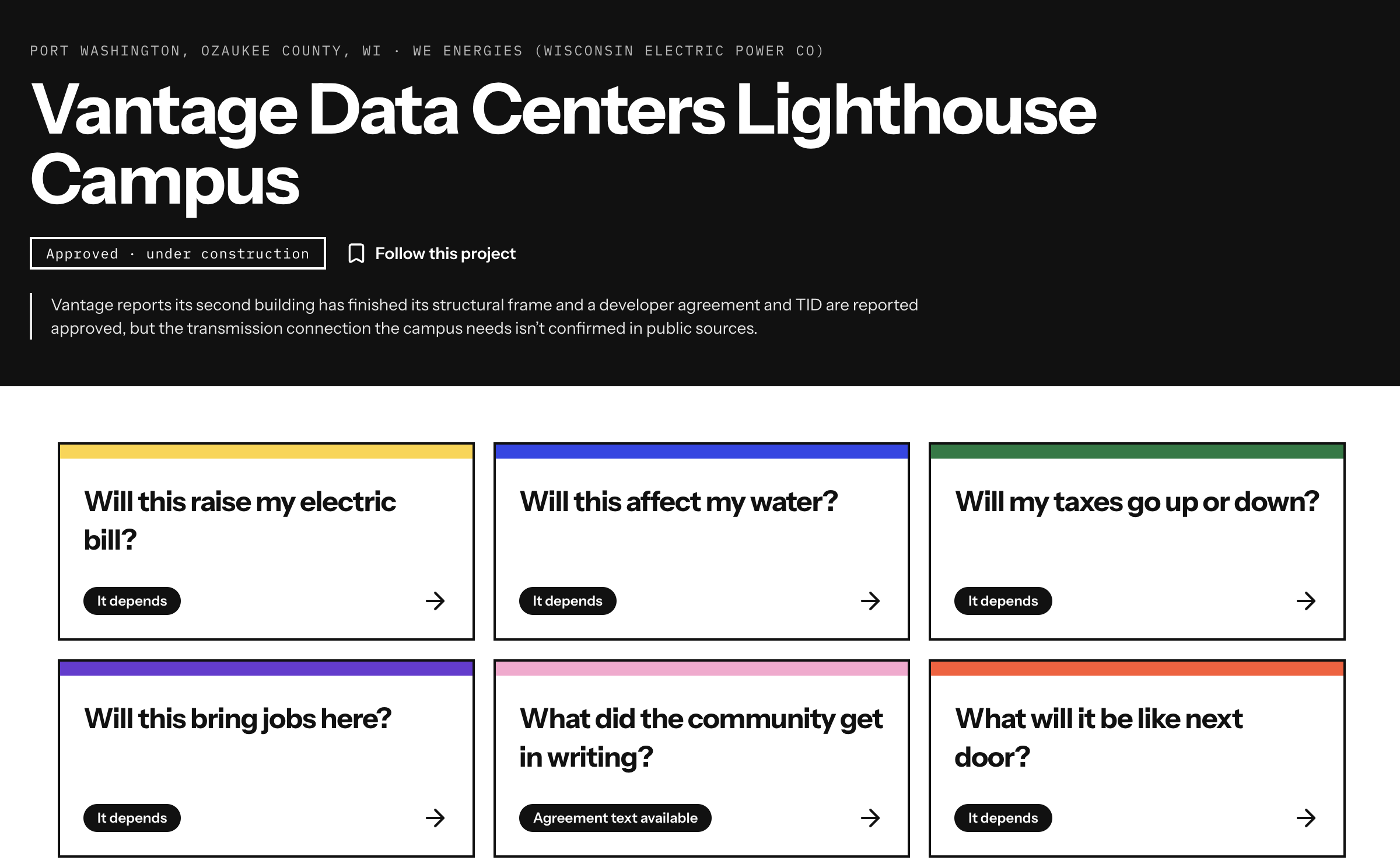
Six starting questions, organized around what a project could change for the people living nearby.
Potential benefits and negatives
The project page starts with potential benefits and negatives, each linked to a source. For Port Washington, those include reported plans for closed-loop cooling, developer-paid impact fees and about 5,000 construction workers at peak, alongside substantial electricity demand, disputed transmission routes and tax incentives. The details matter: construction jobs aren’t permanent jobs, and a tax incentive’s cost depends on its terms. The app keeps those distinctions visible and leaves residents to weigh them.
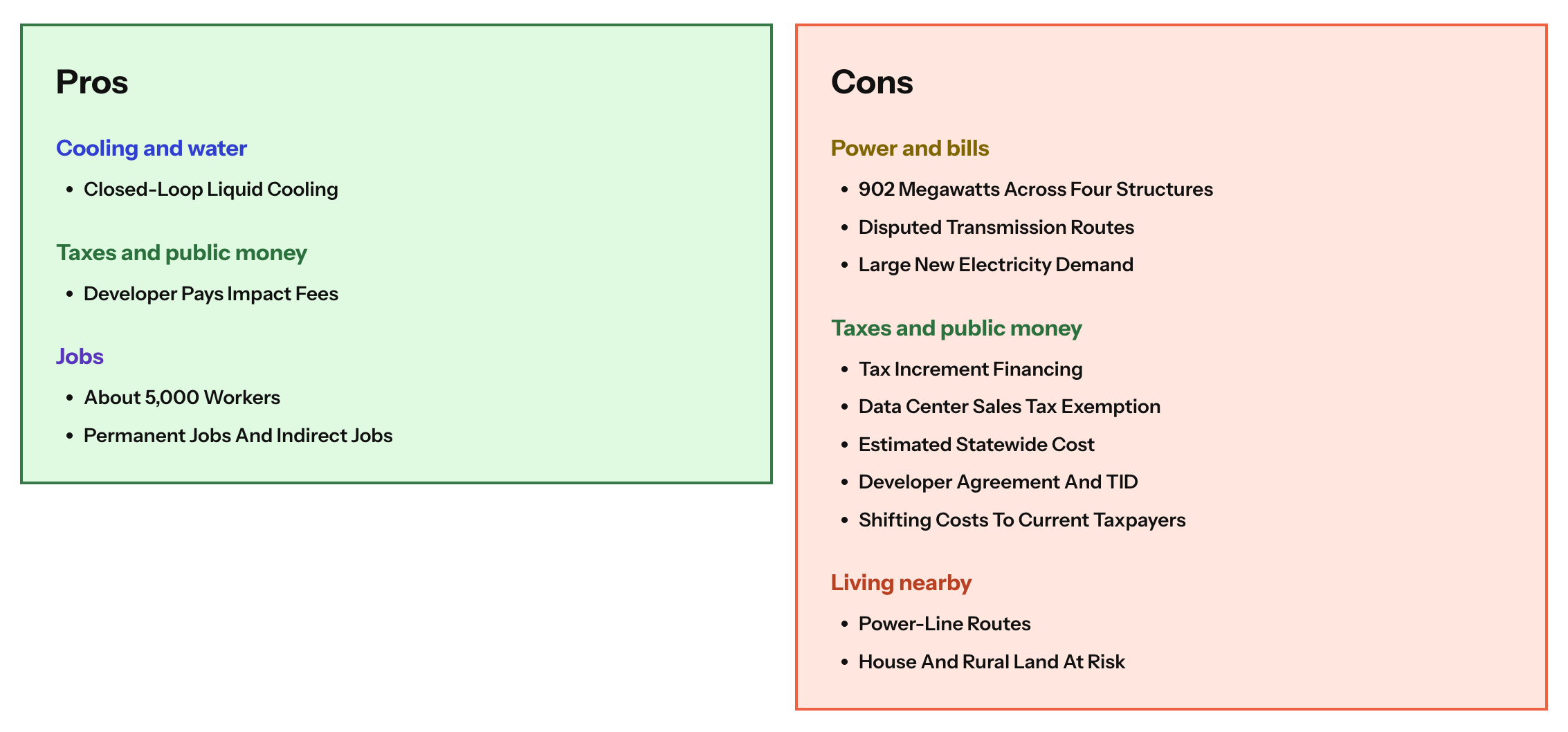
Pros and cons, grouped by topic. No simple yes or no.
A resident starts with “Will this raise my electric bill?” and leaves with a question they can take to the Public Service Commission of Wisconsin: “What rate terms would keep this campus’s electricity and grid-upgrade costs from being charged to households?”
They can save that question, add their own and export a meeting sheet grouped by who can answer. The research becomes something they can bring into the room.
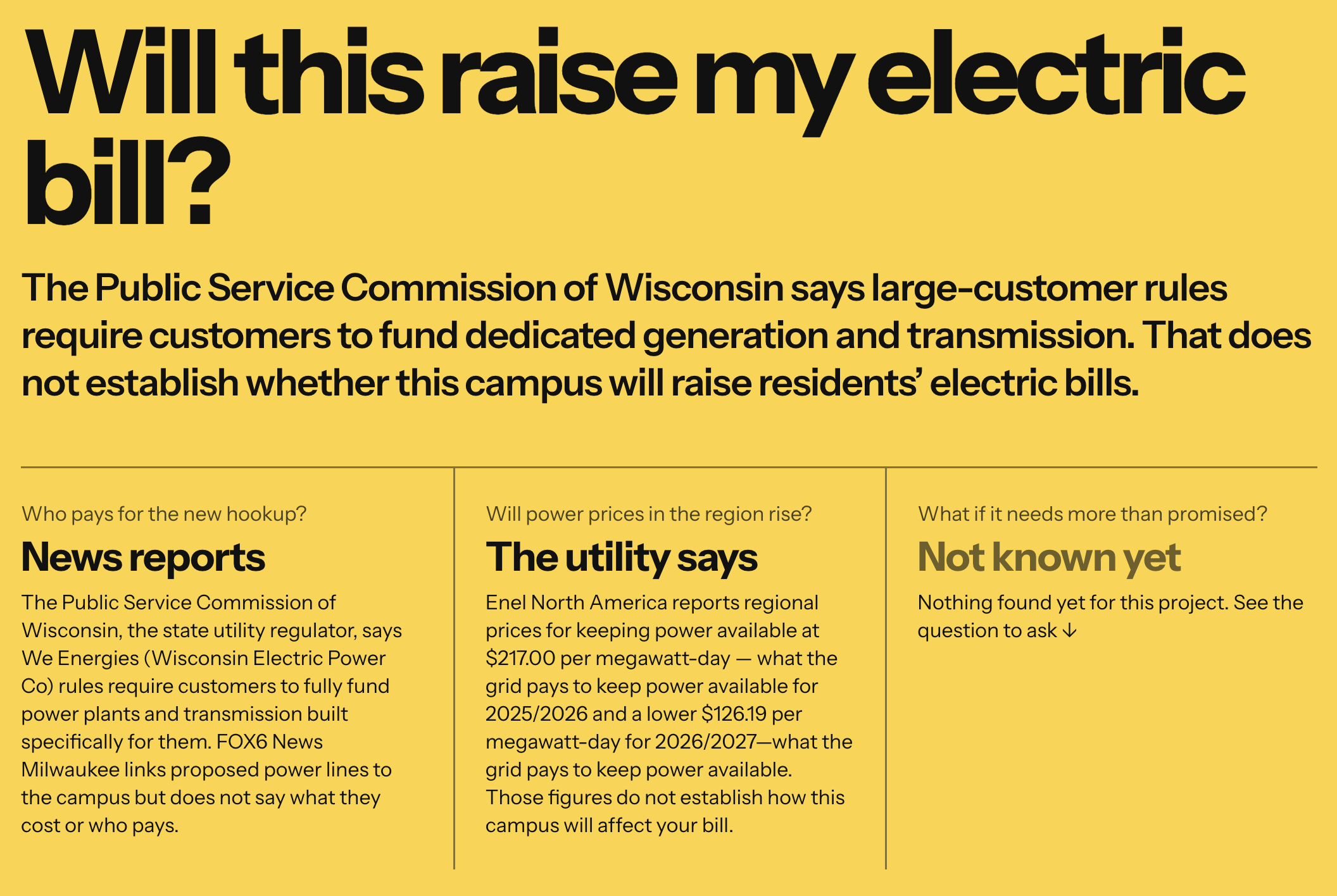
Each finding is labeled by who said it.
A town meeting shouldn’t require a glossary
Highlight any text on the page and get a plain-English explanation, right where you’re reading. You shouldn’t need to open six more tabs to understand the first one.
Select “closed-loop liquid cooling,” for example, and the AI explains how the liquid circulates and is reused. It also helps you see what that phrase leaves unanswered: how much fresh water does the full cooling system need?
From there, you can save a question for the meeting: “How much fresh water would the campus need each day, including during hot weather?”
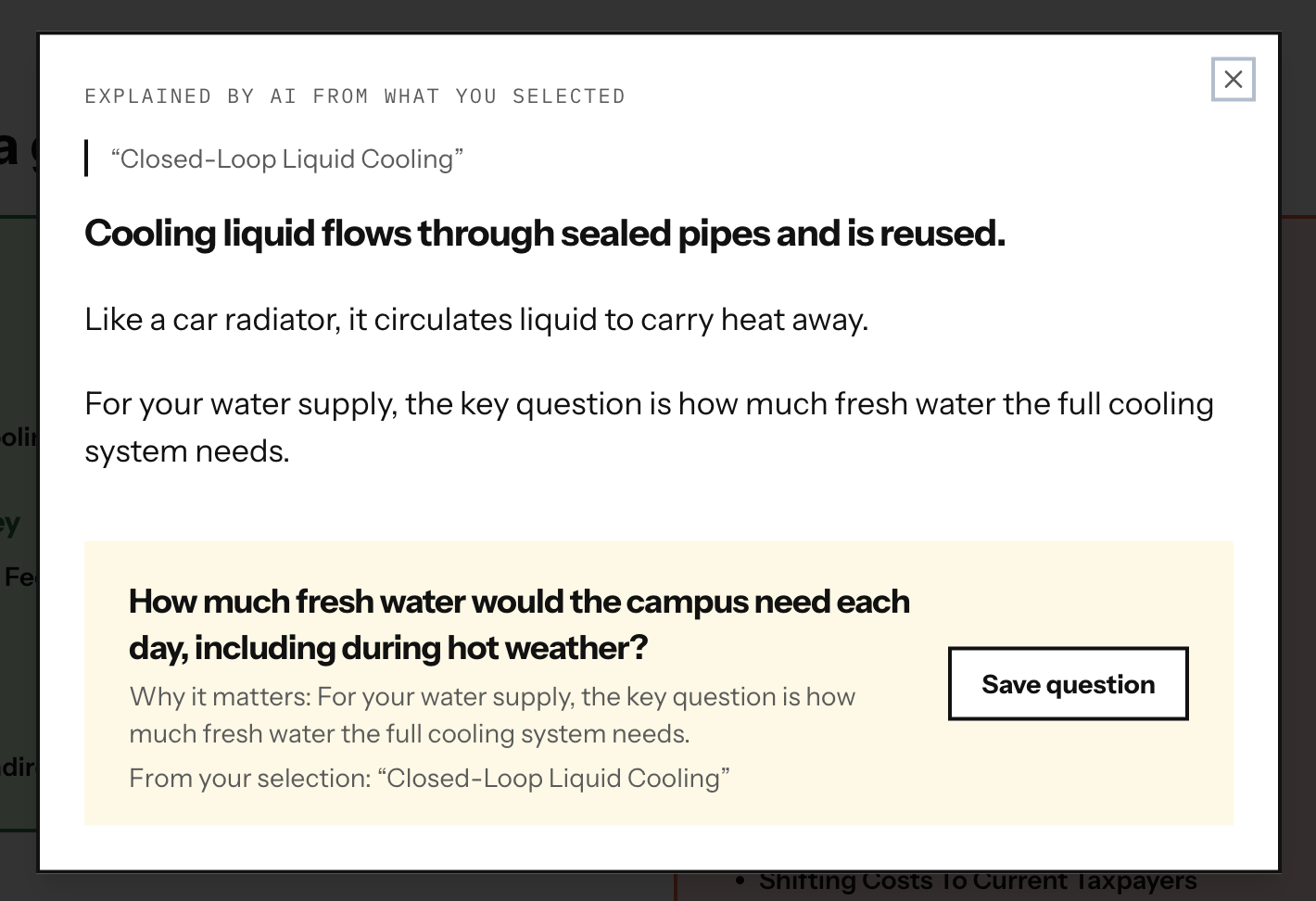
Highlight what you don’t understand. Get an explanation and a question you can take with you.
Follow the Money
A tax break raises another question: what money will actually be available for local services? The records gathered for Port Washington identify tax incentives, but don’t establish Vantage’s exact benefit. The app shows that limit and points residents toward the terms they need to see.
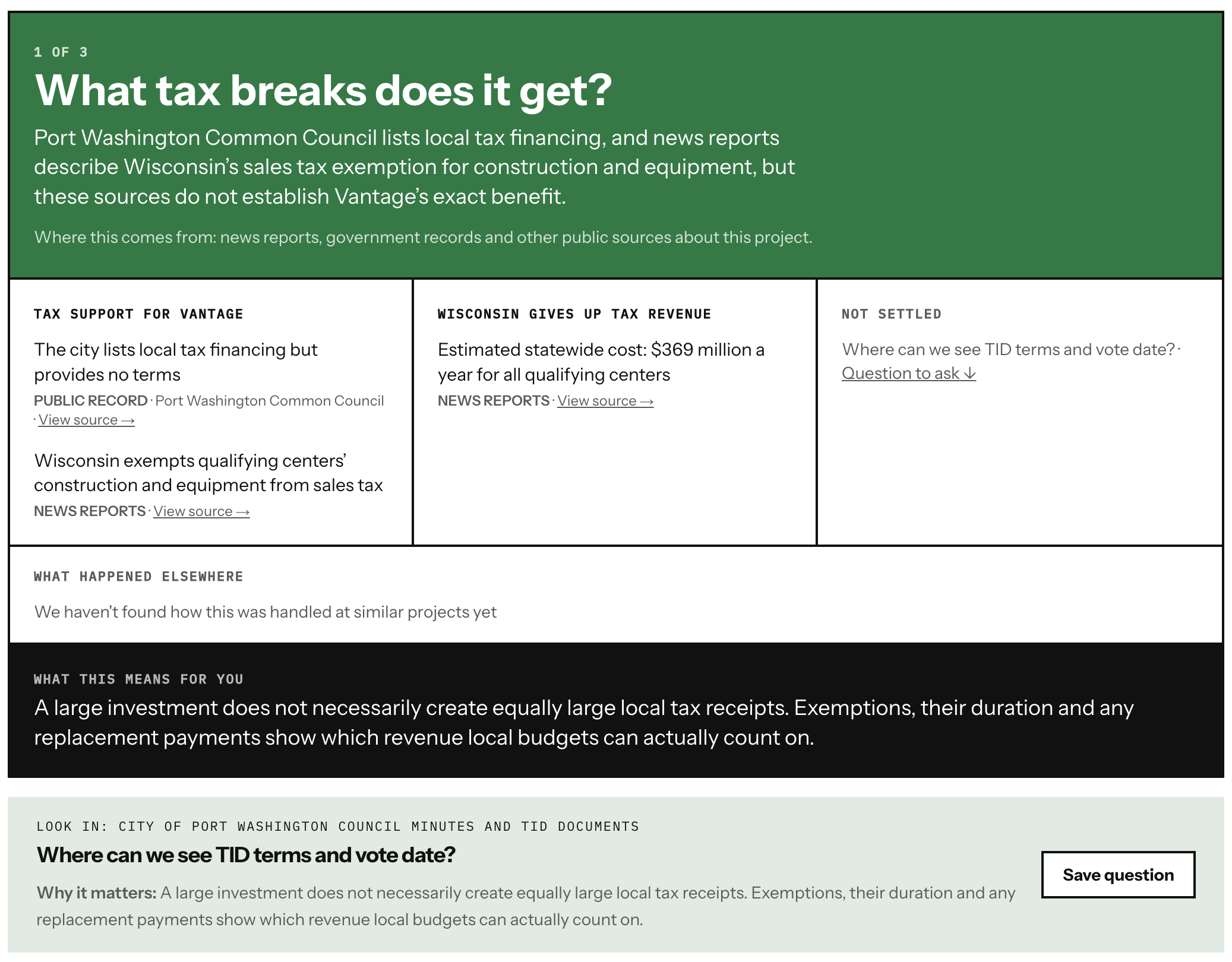
What’s decided and what’s not.
When the research leaves a question unanswered, the app helps residents identify what to ask for and where to take it.
Questions from other towns
Other communities can help residents spot what to ask next. The app looks for projects that share a utility or state. For Port Washington, that includes reporting on electricity-cost concerns around Microsoft’s campus in Sturtevant and a resident petition raising similar concerns in Kenosha. Those concerns don’t establish what will happen here. They point to rate terms residents may want to examine before accepting assurances about their own bills.
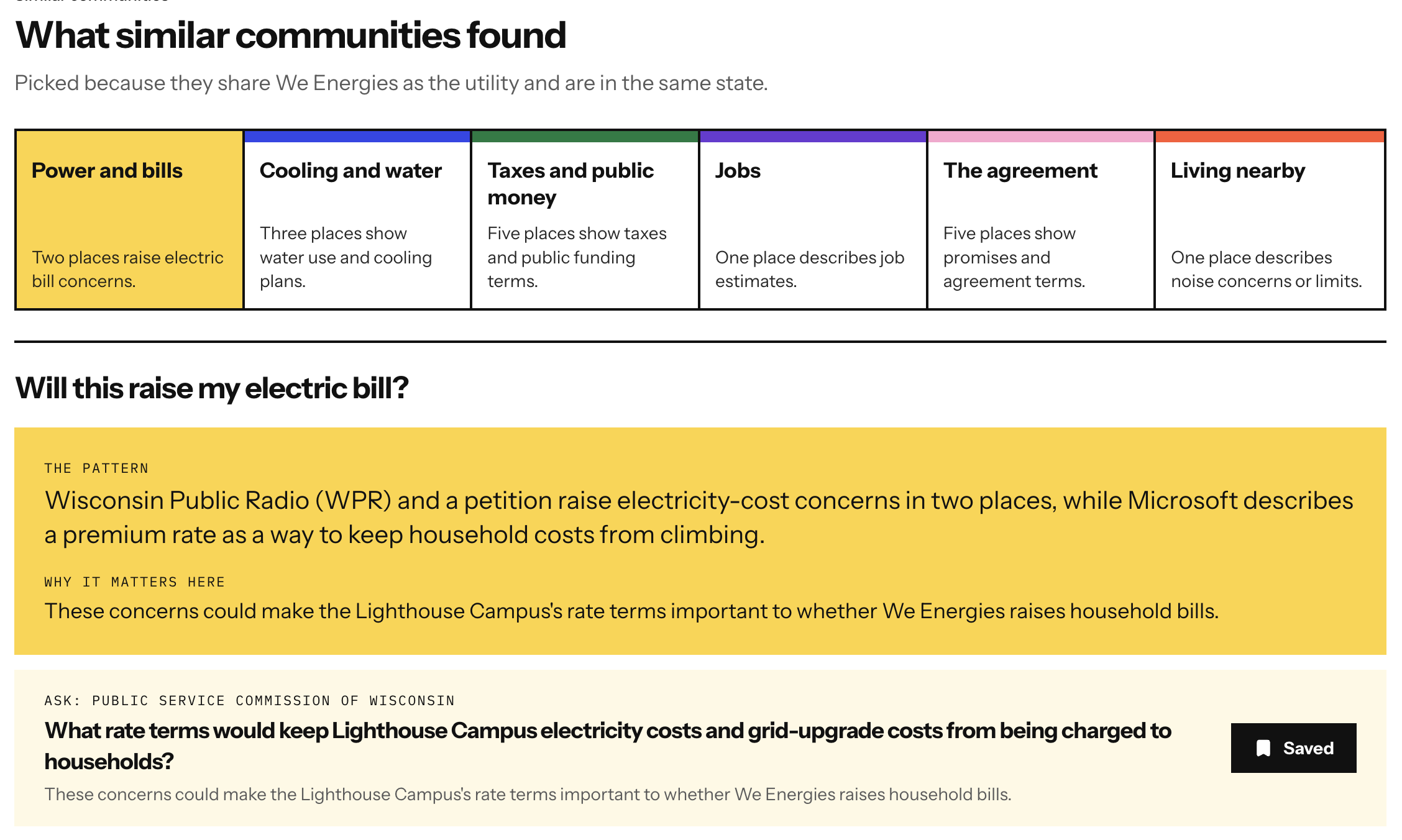
Residents save the suggested questions they want answered, add their own, and the app turns them into a meeting sheet grouped by who can answer them.
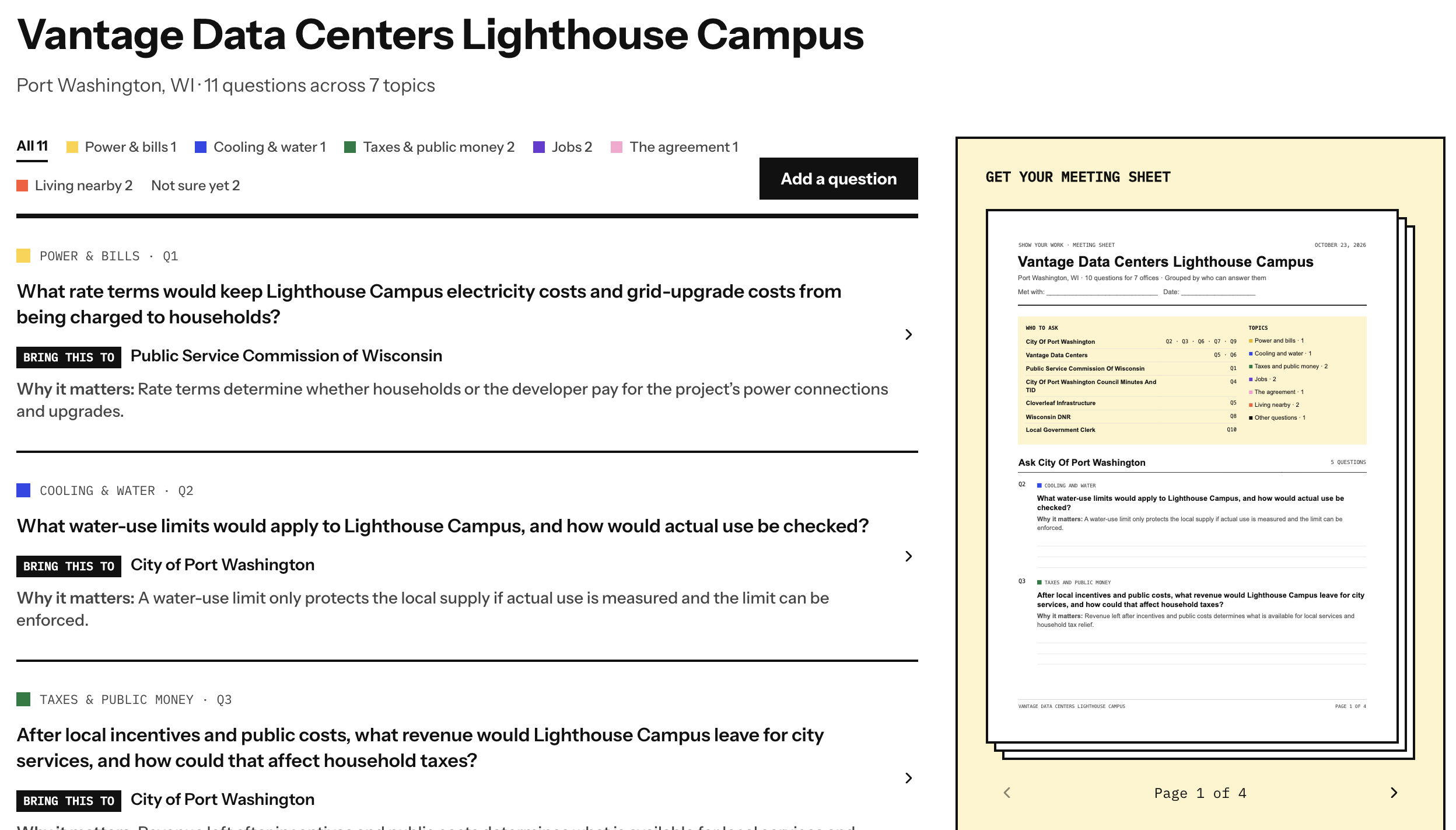
A meeting sheet, ready to save to Google Docs.
That changes what’s possible in a public meeting. People can discuss terms, protections and accountability alongside whether they support the project at all. I want someone who has never read a utility filing to follow that conversation, and contribute something consequential to it.
Show your work. Give people time to question it.
The name is a promise to both people in that room. Show where the number came from. Explain what it means for this town. Say what’s still unknown. Let people check.
AI raises the stakes. A confident summary can make an uncertain claim sound settled. On a decision that could shape a town for decades, people need to see the difference between a developer’s projection, a utility’s statement and a signed commitment.
Sources don’t resolve every disagreement. People can understand the same proposal and want different things for their community. But sources give that disagreement a firmer foundation, and they make it easier to notice when a question hasn’t actually been answered.
I keep thinking about that box breath. The frustration in the room was about being told to do the work while nobody gives you the time to do it. AI should give people more room to exercise their own judgment. Here, that means giving communities the time to reach their own answers.
If a data center is coming to your town, try Show Your Work.
