The Best Software Might Be the Software You Delete
For most of my career, software was something you committed to.
You didn't just decide your team needed a better way to track projects. You chose Jira. Or Asana. Or Notion. Then you configured it, migrated things into it, convinced everyone to use it, figured out what the hell your statuses should mean, and eventually developed a small civilization around it.
You were, in a sense, getting married. And you had to get married before you really knew what you needed.
I'm starting to think AI flips that assumption. Software should start temporary.
Permanence is something it earns.
Here's what that looks like in practice. Over the last six months at my tiny startup, I haven't introduced a single new general-purpose tool. We use durable infrastructure where it makes sense: Sentry, GitHub, Supabase etc. But no Notion. No Linear. Not even an elaborate running Google Doc.
Instead, whenever something annoys me enough, I build something.
I needed to wrap my head around who I was meeting at events who wanted to join our beta waltist. so I built a little tool for it. We used it for a few weeks, made our decisions, and never opened it again. Perfect.
And I threw together a scrappy github + non-eng tasks tracking system, fully expecting to delete it. Six months later I'm in it every day. That one might deserve to become real infrastructure.
I know what this sounds like. It sounds like prototyping. It isn't.
A prototype is temporary because it's on its way somewhere. You build it to learn what the real software should be. Disposable software isn't on its way anywhere. My waitlist tool wasn't a prototype of a waitlist tool. It was the tool. It did the job. Then the job ended.
We have always treated temporary software as unfinished software. What if temporariness is a feature?
This the Ziploc bag theory of software.
If you have kids, you already understand the extraordinary versatility of a Ziploc bag. Before a trip, I give each of my kids one and tell them they can fill it with whatever random objects they absolutely insist must come with us.
Tiny Lego guy? Fine.
A rock of large significance? Fine.
Snacks? Ziploc. Wet clothes? Ziploc. Emergency throw-up bag? Extremely important Ziploc.
Eventually it gets gross or ripped and you throw it away (or it just disappears on its own).
The Ziploc is not the best container for any of these jobs. That is exactly why it is useful. It is cheap, flexible, immediate and radically under-designed. You don't spend forty-five minutes researching the optimal container for the weird rock collection your kid needs to carry through LAX. You grab a bag.
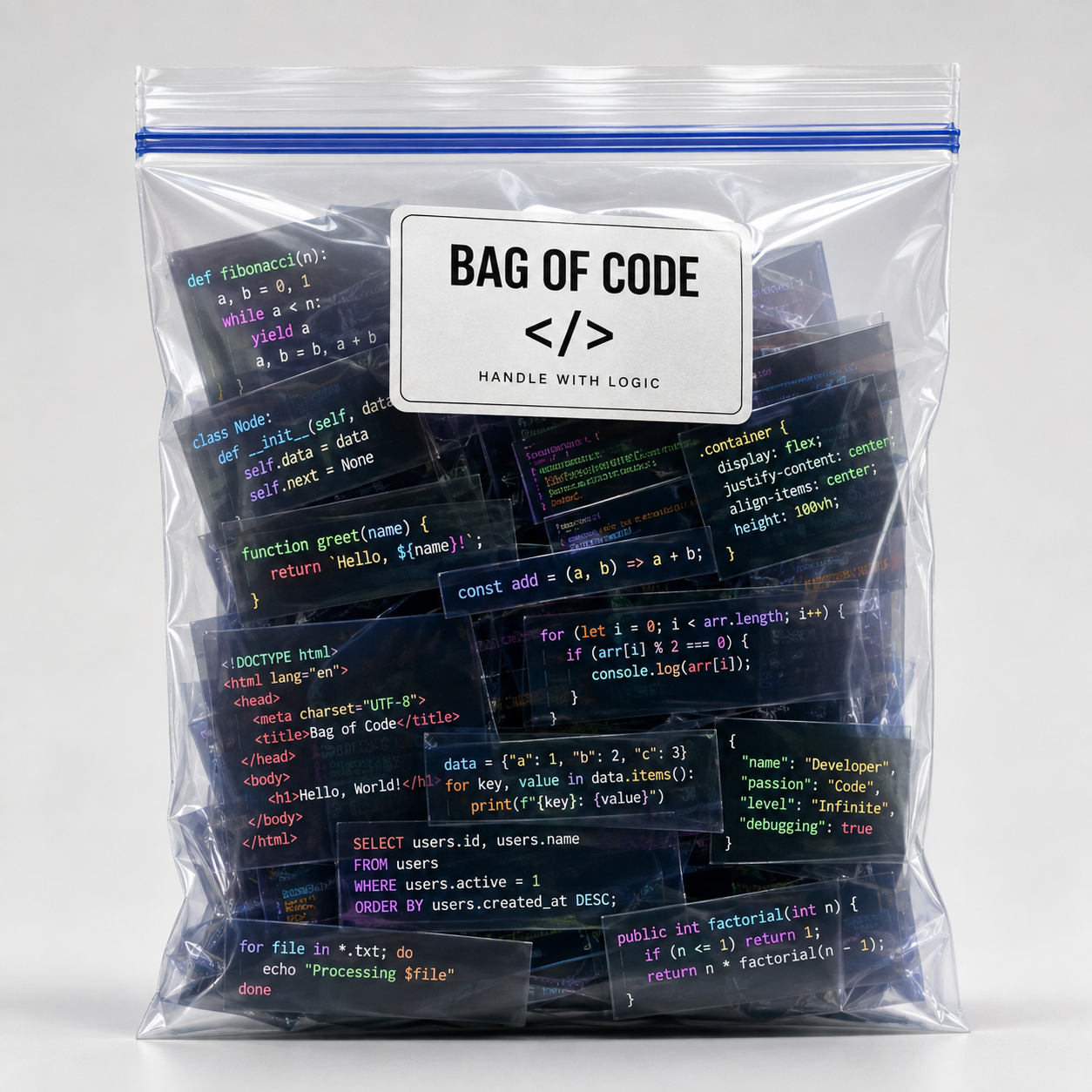
For most of software history, you couldn't grab a bag. Even a tiny custom tool cost enough that you had to ask whether the problem justified building software at all. Which meant software had to serve enough people, for long enough, to pay back its cost of creation.
That constraint is dissolving. And when it dissolves, something stranger happens than software just getting cheaper.
The unit of software shrinks.
We used to buy products that solved categories of problems: project management, CRM, knowledge management. Now you can build software for this particular problem, for these particular people, for this particular moment. Not "project management software" but the thing three of us use until October to decide which bugs block the Friday release.
Then October comes. Delete.
No SaaS company would ever build that product. That's the point. It's not just cheaper software. It's a new granularity of software.
And the strange endpoint isn't only bespoke company dashboards. Some software may have a total addressable market of one. One person. One family. One vacation. One school year. One peculiar problem that lasts eleven days. Historically that wasn't a viable unit of software, because nobody could build a business selling an app to one parent for three weeks of August. But if that parent can summon it herself? Then software no longer necessarily needs a market.
And occasionally something refuses to die. You build a disposable tool and six months later you're still opening it every day, like my accidental admin panel.
That's when maybe you don't have a Ziploc anymore. Maybe you need a Stasher Silicone Bag.
